
이만재 기자 ㅣ 여행레저신문
In the heart of the capital, Joseon survives not in spectacle, but in silence
By Dr. Howard Johnson
Cultural Historian, UK
There are places in Seoul that announce themselves with light, noise, and movement. Jongmyo does the opposite. You do not so much arrive there as fall into it. One moment you are standing beside the restless current of modern traffic on Yulgok-ro, and the next you are facing a long wall, a low gate, and a silence so composed that it seems to have been guarded for centuries.
For a foreign visitor, especially one raised among the cathedrals, cloisters, and stone memory of Europe, Jongmyo comes as a surprise. It is not visually exuberant. It does not seek to overwhelm the eye. Its power lies elsewhere — in restraint, proportion, emptiness, and the quiet confidence of a civilisation that believed moral order could be expressed through architecture.
Jongmyo was built in 1395, soon after the founding of the Joseon dynasty, and it was never intended as a mere memorial to the dead. It was one of the spiritual foundations of the state. In old Korea, the phrase Jongmyo-sajik did not simply refer to ritual sites. It meant the continuity of the dynasty, the legitimacy of rule, and the survival of the realm itself. To protect Jongmyo was to protect the nation’s soul.
That helps explain why the shrine feels different from other royal sites in Seoul. Gyeongbokgung may speak of authority. Changdeokgung may reveal elegance and adaptation to landscape. But Jongmyo speaks of duty — duty to ancestry, to order, to memory, and to the invisible structure that held Joseon together for more than five centuries.
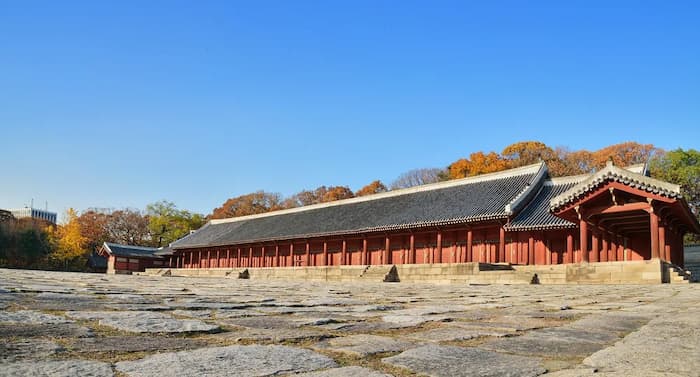
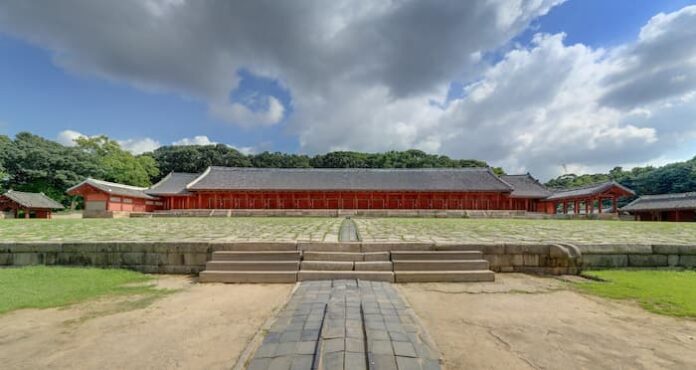
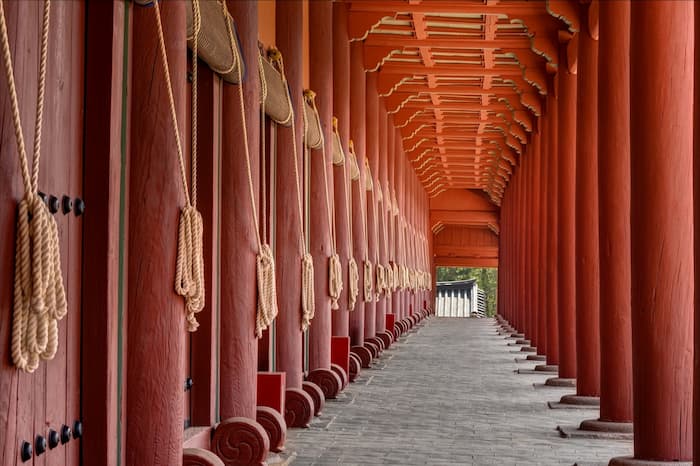
At the heart of the complex stands Jeongjeon, the main hall, a building of extraordinary length and composure. It is often described as austere, and indeed it is. Yet austerity here is not absence. It is intention. Each chamber houses the spirit tablets of kings and queens, and the repetition of doors, stones, and timber creates a rhythm that feels almost liturgical. One senses that this is not architecture designed to impress a visitor for a moment, but to discipline the mind over generations.
Nearby stands Yeongnyeongjeon, the Hall of Eternal Peace, where those later honoured by the dynasty were enshrined. Even this distinction between halls tells us something profound about Joseon. Bloodline, legitimacy, posthumous honour, and moral worth were not casual matters. They were arranged, debated, ritualised, and ultimately fixed into sacred space.
But Jongmyo was never complete without ceremony. It existed to be used. The royal ancestral rites performed here were not decorative survivals from a vanished age. They were the visible enactment of Confucian kingship. The king did not merely govern the living. He stood in continuity with the dead, and before the court, the musicians, and the ritual order of the shrine, he demonstrated that rule itself was an ethical burden.
This is why the music of Jongmyo matters so deeply. Jongmyo Jeryeak is not background sound. It is statecraft in audible form. The slow percussion, the grave wind instruments, the measured chant, and the restrained ritual dance all combine to produce something that feels less like performance than alignment — as if heaven, earth, ruler, and ancestor are being briefly brought into harmony. For Western ears accustomed to climax and emotional flourish, the experience can seem severe at first. Then it begins to work inwardly. One stops waiting for drama and starts hearing structure.
Perhaps that is the great lesson of Jongmyo. So much of modern urban life is built around acceleration, interruption, and display. Jongmyo proposes another idea of civilisation: that endurance comes not from speed, but from form; not from noise, but from repetition; not from spectacle, but from reverence.
There is also a wound in the landscape. Jongmyo was once linked to Changdeokgung by the royal path known as the Eodo, the road reserved for the sovereign. During the Japanese occupation, that symbolic axis was broken apart and modern roads cut through the historical fabric. Yulgok-ro, today busy and functional, sits atop a scar as much as a street. To understand Jongmyo fully is to understand not only what Joseon built, but also what colonial modernity tried to sever.
And yet Seoul remembers. That, too, is part of the experience of visiting Jongmyo today. The city around it surges forward with all the appetite of the twenty-first century, but inside the shrine precinct, another rhythm survives. The air feels slower. The geometry of the courtyards steadies the eye. Even the emptiness seems inhabited.
I have often thought that great capitals reveal themselves not first in their palaces or markets, but in the places where they honour the dead. London has Westminster Abbey. Paris has Saint-Denis. Seoul has Jongmyo — less theatrical, perhaps, but in some respects more profound. It does not ask for admiration. It asks for composure.
And so Jongmyo remains one of the few places in Seoul where Joseon is not reconstructed, branded, or performed for convenience. It is simply there: patient, grave, and astonishingly intact. In a city that changes with remarkable speed, Jongmyo reminds us that memory is not the opposite of progress. It is what prevents a civilisation from becoming weightless.
To walk into Jongmyo, then, is not merely to enter a heritage site. It is to step into the moral imagination of old Korea — and to discover, amid stone and silence, that some parts of Seoul still whisper in the language of kings.
여행레저신문 Copyrights ⓒ The Travel News. 무단전재 및 재배포 금지.