
이가온 기자 ㅣ 여행레저신문
A Thousand-Year Temple in the Middle of Gangnam
There are places in Seoul that seem to belong to two different civilizations at once. Bongeunsa is one of them.
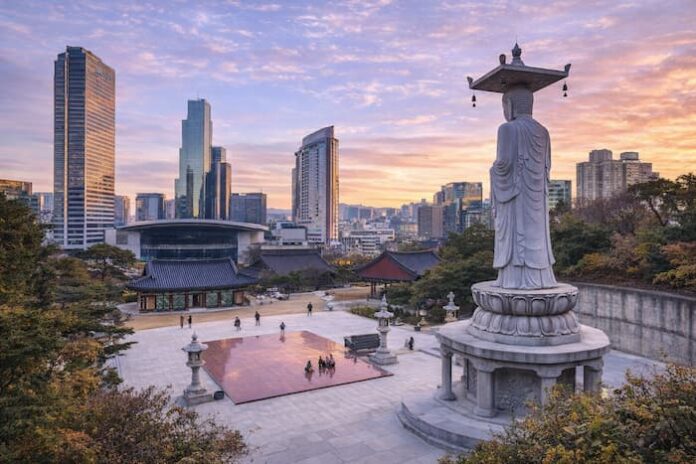
Step out of the polished glass world of Gangnam, past COEX and the trade towers, and you suddenly find yourself entering a temple first founded in 794 during the Silla Dynasty. Bongeunsa is not hidden in a remote mountain valley, nor does it ask you to leave the modern city far behind before you reach it. It stands right in front of one of the busiest commercial districts in Korea, and that is precisely what makes it so memorable. Official sources describe it as a temple first established in 794, originally under a different name, and later rebuilt and expanded at its present site, where it became closely associated with royal patronage in the Joseon period.
Most Korean temples are imagined as mountain sanctuaries. That image is not wrong, but it is incomplete. Bongeunsa offers another face of Korean Buddhism: a great urban temple that has survived political shifts, dynastic change, modernization, and the explosive rise of Seoul’s southern districts. Visit Seoul notes that the temple was founded in 794 and today holds more than a thousand years of history, even as it stands in the heart of contemporary Gangnam.
What makes Bongeunsa unusual is not only its age, but its setting. Across the road, Seoul performs its most modern self: convention halls, luxury hotels, department stores, offices, traffic, screens, and money. Inside the temple grounds, the rhythm slows. Courtyards widen. Wooden halls breathe. Stone paths absorb the noise. This contrast is not simply picturesque. It feels like a quiet argument about what a city is for. Bongeunsa does not take you backward into nostalgia. It suggests something else: that the future of urban life may still need silence, ritual, and inner balance. That is an interpretation rather than a formal historical claim, but it is exactly the impression the place leaves on many visitors.
Historically, Bongeunsa also matters because it was not just a neighborhood temple. During the Joseon era, it became an important temple connected to the royal court, and its name took shape in that context. Official Korean tourism sources note that it was refurbished in 1498 by Queen Jeonghyeon and renamed Bongeunsa. The temple’s own English materials also emphasize its role in the revival of Korean Buddhism and its long institutional importance.
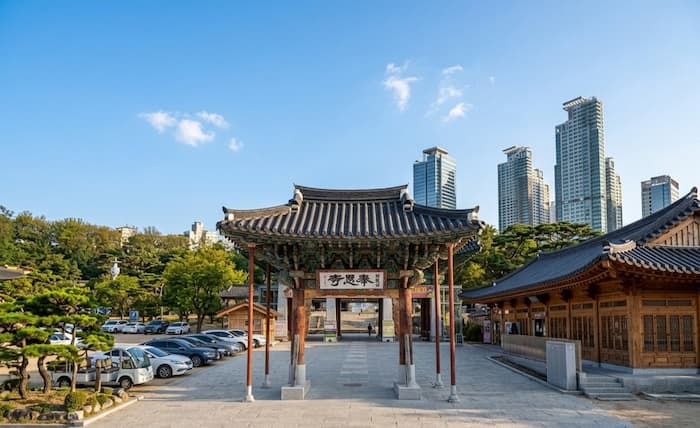
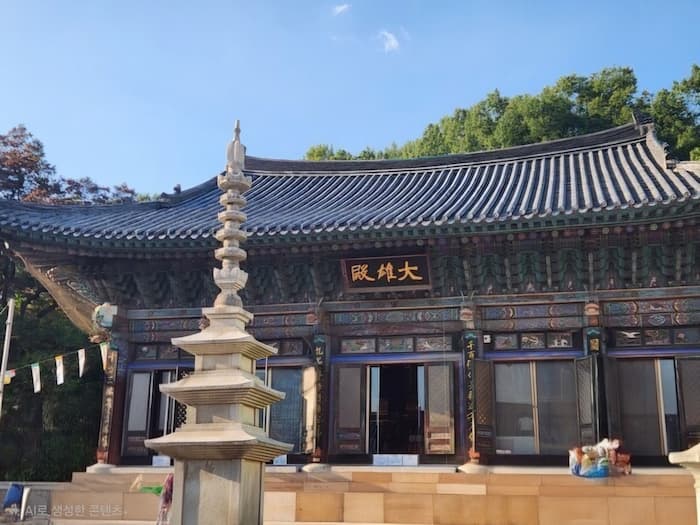
The temple is also known for what visitors can actually see and feel. There are the traditional halls, the broad courtyard, and the famous giant standing statue often identified as Mireuk Daebul, or Maitreya Buddha, which has become one of Bongeunsa’s visual signatures. Seoul’s official tourism materials highlight the temple’s major halls and cultural assets, while the temple’s own site frames it as both a religious and cultural space in the middle of the city.
For foreign visitors, Bongeunsa becomes especially valuable because it is not difficult to reach and it offers more than a photo stop. It is one of the temples connected to Korea’s official templestay network, where visitors can experience elements of Buddhist monastic culture rather than only observe them from the outside. The English templestay portal and Bongeunsa’s own English pages describe programs that include temple tours, tea, Buddhist cultural activities, and short experiential sessions, with current listings including one-day and evening-oriented options.
That practical point matters. Many English-language travelers are curious about Korean Buddhism, but do not know where to begin. Bongeunsa is one of the easiest starting points in Seoul because it combines accessibility with depth. You can come here as a casual traveler with one free hour, or you can reserve a program and stay longer through a templestay-style experience. According to the official templestay listings, Bongeunsa currently offers programs such as a Sunday evening experience and a Thursday temple tour and tea program, though schedules can change and should be checked before visiting.
There is also something symbolically fitting about beginning a Korean temple series with Bongeunsa. In many countries, religious sites survive by withdrawing from the center. Bongeunsa did the opposite. It remained in place while the city around it became richer, louder, and faster. Today it faces one of the most globalized parts of Seoul without surrendering its identity. That is why it feels less like a relic of the past and more like a proposition for the future: a reminder that modernity without stillness becomes exhausting, and prosperity without inward life feels thin.
Templestay and Practical Visitor Information
Bongeunsa is located at 531 Bongeunsa-ro, Gangnam-gu, Seoul, directly across from the COEX area, making it one of the most accessible major temples in the city. Official tourism and templestay sources confirm both the address and its easy urban location.
Visitors interested in templestay should check the official English templestay site before going, because available programs, dates, and reservation conditions may change. The current official listings show short-format experiences at Bongeunsa in addition to general temple information.
A good first visit is simple: arrive in the late afternoon, walk slowly through the grounds, spend time near the main courtyard and the great statue, and let the contrast between the temple and Gangnam do its work. Bongeunsa is not just a place to “see.” It is a place to notice how a city sounds when silence is still allowed to exist inside it.
By Jungchan Lee
Publisher, The Travel News
여행레저신문 Copyrights ⓒ The Travel News. 무단전재 및 재배포 금지.