
강정호 기자 ㅣ 여행레저신문
Gwanaksan: Where Seoul Ends and Korea’s Mountain Spirit Begins
By Manjae William Lee | The Travel News
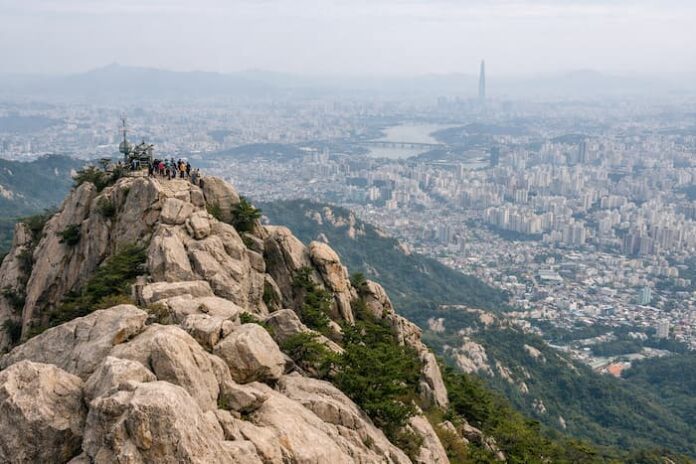
There are cities that keep their mountains at a distance, placing them somewhere beyond the suburbs, beyond the highways, beyond the daily reach of ordinary life. Seoul is not one of them. In Seoul, mountains arrive quickly. They rise behind apartment blocks, above university roads, beside traffic and train lines, as if reminding the city that it was built not on empty land but in conversation with stone, water, wind, and memory. Among those mountains, Gwanaksan is one of the clearest places to understand what makes Korea’s mountain culture different. It is not the highest peak in the country, nor even the tallest in Seoul, but it possesses something more immediate: character. Official tourism information describes Gwanaksan as a 632.2-meter mountain with rugged rocky peaks and deep valleys, a place close enough to the city for a day trip and yet dramatic enough to feel distinctly wild.
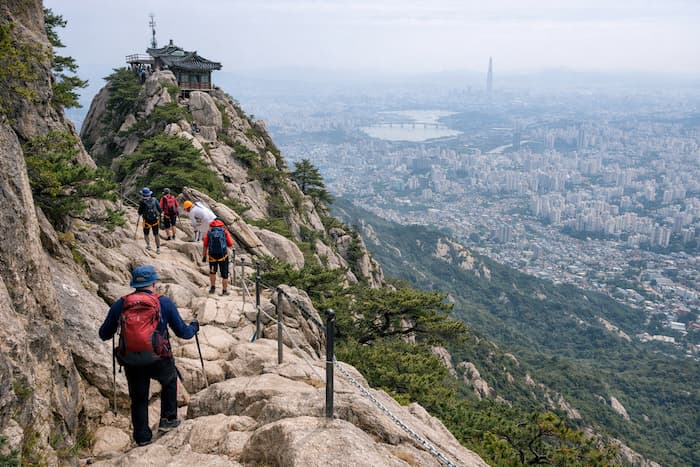
That first contrast is what stays with a foreign walker. A subway ride ends, a road bends, and suddenly the air changes. The noise of the city does not vanish at once, but it begins to lose authority. Granite starts to dominate the landscape. The ridges rise in uneven, muscular lines. Pine trees cling to rock as if they have signed an old contract with the mountain. Gwanaksan does not feel soft or ornamental. It feels stern, weathered, and alert. Korea Tourism Organization materials note that the mountain’s many rocky peaks and valleys give it a rugged impression, and that is exactly right. It is a mountain that seems to introduce itself first through texture rather than height.
Its name already carries a story. According to the Encyclopedia of Korean Culture, Gwanaksan was called so because its summit resembled a traditional Korean hat, a gat, creating the image of a crowned mountain. The same source records that it was also known as Sogeumgang or Seogeumgang—“Little Geumgang” or “Western Geumgang”—because of its beautiful rocky scenery. These older names matter. They show that Koreans did not see Gwanaksan simply as a hill near the capital. They saw shape, dignity, and resemblance. They looked at stone and found metaphor in it.
Gwanaksan also stands deep inside the historical imagination of Seoul. Traditional geomantic thinking regarded it as a mountain with strong fire energy, a force so powerful that it had to be balanced when the Joseon capital was established in Hanyang. The Korean encyclopedia records the long-standing belief that the mountain’s fiery energy was one reason for symbolic countermeasures such as the placement of protective features in the capital. Another entry notes that traces of ponds and water features around the mountain were also connected to efforts to suppress that fire energy. Whether one reads this today as belief, political symbolism, or landscape philosophy, the point is the same: in Korea, mountains were never just physical backdrops. They were actors in the fate of a city.
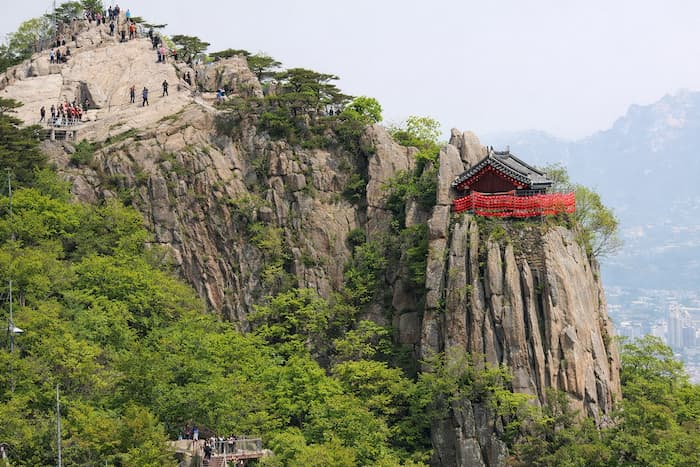
No place on Gwanaksan expresses that fusion of topography and memory more powerfully than Yeonjudae and Yeonjuam. At the summit area are temple sites and hermitages closely tied to early Joseon history. Korea Tourism Organization describes Yeonjuam Hermitage near the top as one of the mountain’s defining landmarks and notes traditions linking summit temples to King Taejo’s efforts to ward off misfortune when he moved the capital to Seoul. The Encyclopedia of Korean Culture adds more emotional depth: the name Yeonjudae is associated with longing for the old dynasty and gazing toward Songdo, the former Goryeo capital. Later traditions also connect the site to Princes Yangnyeong and Hyoryeong, who are said to have stayed there after courtly upheaval. On that high stone platform, history does not feel abstract. It feels like something that climbed here, looked back, and could not easily let go.
For an outsider, that is one of the most striking aspects of hiking in Korea. A mountain trail here is rarely just a recreational route. It is often a corridor through religion, kingship, folklore, and daily urban life at the same time. Gwanaksan has long been a favorite hiking destination because it is close to the city, yet the mountain is layered with temples, shrines, cliff paths, and old names that reward anyone willing to walk more slowly and read the landscape as culture. The official Seoul and national tourism descriptions both emphasize its accessibility, but they also make clear that the mountain is not gentle merely because it is nearby.
That point deserves emphasis, especially for foreign visitors. Gwanaksan may sit beside a global city, but it is not a casual urban stroll. The Korea Tourism Organization’s 2025 hiking guide classifies it among Seoul’s more challenging mountain walks and specifically advises proper warm-up, hiking boots, and extra care because the ridge trail involves repeated ascents and descents over rocky terrain. The guide also recommends gloves or hiking sticks to make the route easier. For beginners, that advice should not be treated as optional. A mountain close to the city can still punish overconfidence.
This is where Korean hiking culture becomes especially interesting. In many countries, hiking still carries the image of escape from civilization. In Korea, it often feels like an extension of civilization—disciplined, social, and surprisingly well-prepared. Older hikers move with admirable efficiency. Many carry poles, layered clothing, water, fruit, and simple trail food. There is a seriousness to it, but not a grim one. It is a culture of respect: respect for the mountain, for weather, for routine, for one’s own limitations. Seoul has recognized the popularity of this culture strongly enough to establish the Seoul Hiking Tourism Center at Gwanaksan Station, where foreign visitors can obtain information and even access services related to hiking gear. That is not a small detail. It shows that in Seoul, hiking is not a fringe pastime. It is part of how the city introduces itself.
So what should a first-time foreign hiker actually bring to Gwanaksan? The answer is simple and practical: proper hiking shoes with grip, enough water, light snacks, a windproof layer, and, if possible, gloves or hiking poles. On warm days, sun protection matters. On colder or windy days, exposed ridges can feel harsher than expected. Trails can become slick after rain, and rocky sections demand attention on descent as much as on ascent. The best approach is not bravado but pacing—start early, follow marked routes, and remember that a 632-meter mountain can feel much larger when the trail rises and falls over stone instead of unfolding on soft forest earth.
There is also a cultural etiquette worth learning. Korean mountains are active shared spaces. People greet each other. They step aside. They pause at viewpoints without claiming them for too long. Temples and hermitages are not merely scenic decorations for photographs; they remain places of devotion. A foreign visitor who understands this will enjoy Gwanaksan more deeply. The mountain becomes not just a physical challenge but an introduction to Korean habits of coexistence—between city and nature, between effort and contemplation, between history and present-day life.
What makes Gwanaksan especially meaningful as the beginning of a series on Korean mountains is that it teaches the essential lesson early. Korea’s mountains are not always vast in the Alpine sense. Many are not remote. Some stand astonishingly close to crowded neighborhoods, subway stations, campuses, and apartment districts. Yet once entered, they reveal a different scale of experience. Height becomes less important than relation: relation to memory, to legend, to the capital, to the people who keep returning. Gwanaksan is one of those mountains that explains a country not by size, but by nearness.
Standing on its rocky heights, one sees not only Seoul spread below but also a clue to why mountains matter so deeply in Korea. They are not simply visited. They are revisited. They are not scenery outside life; they are folded into life itself. Gwanaksan, with its stern granite face, summit legends, old temples, and demanding ridges, is therefore more than a good hike near Seoul. It is one of the finest introductions to the Korean mountain spirit a foreign writer could ask for.
여행레저신문 Copyrights ⓒ The Travel News. 무단전재 및 재배포 금지.