
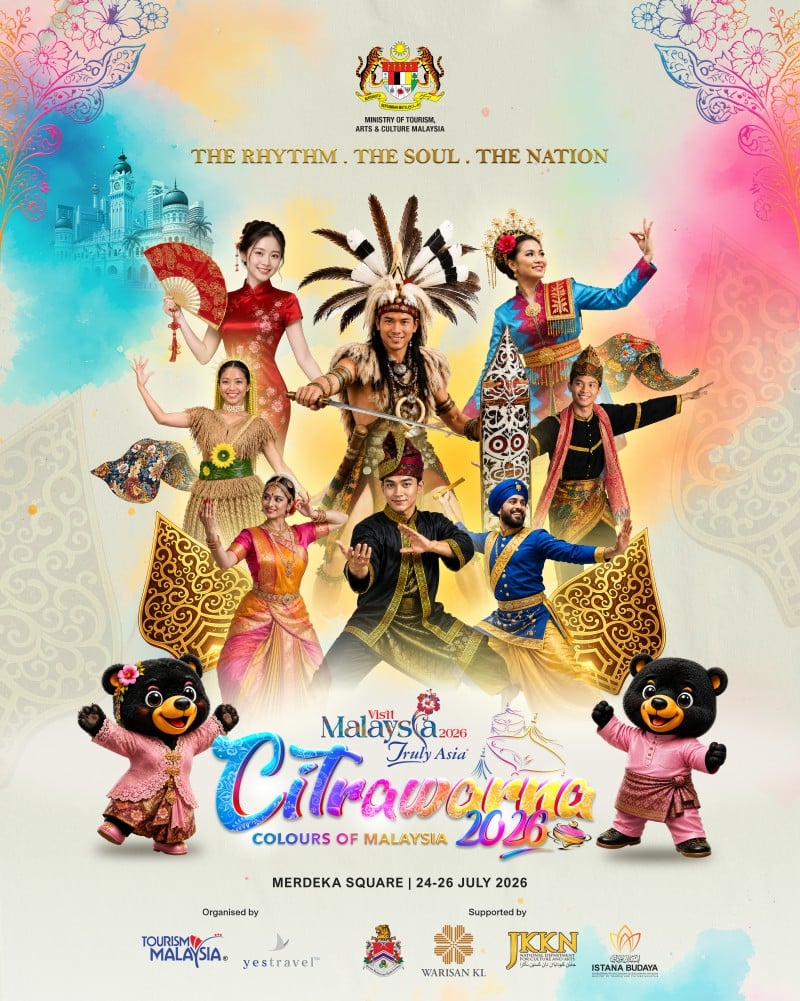
For three days, the ceremonial heart of Kuala Lumpur will become a map of Malaysia in motion.
Dancers, musicians, cooks, craftspeople and performers from across the country will gather at Dataran Merdeka from 24 to 26 July for Citrawarna 2026, a cultural festival designed to present Malaysia not as a single image, but as a nation composed of many distinct traditions.
Admission is free. The centrepiece will come at 8pm on 25 July, when 14 contingents representing different parts of Malaysia move through the square in the Colours of Parade, a large-scale night procession of traditional dress, music and dance.
The festival’s name is commonly rendered in English as Colours of Malaysia. It suggests more than colour in the literal sense: it is an image of the country formed through its different communities, landscapes, foods and ways of life.
This year’s theme, The Rhythm. The Soul. The Nation., places that diversity at the centre of Malaysia’s tourism campaign for 2026.
Four ways to experience Malaysia in one square
Citrawarna is divided into four strands.
Colours of Culture will bring traditional performances and community activities to the square. Colours of Flavour will offer food from different parts of the country, while Colours of Art will feature craft, exhibitions and interactive cultural programmes.
Colours of Parade will bring those elements together in the festival’s main public spectacle.
The format matters. Malaysia is too geographically and culturally varied to be understood through a single city or resort. Peninsular Malaysia, Sabah and Sarawak each carry different histories, cuisines and traditions. Travellers on a short visit may see only a fraction of them.
At Citrawarna, those differences are brought into one public space. A visitor can encounter regional music, clothing, food and craft without leaving central Kuala Lumpur.
That makes the festival particularly useful for first-time visitors. It functions as both a celebration and an introduction — a glimpse of places that may become the next journey.
Why Merdeka Square matters
The setting gives the festival much of its weight.
In Malay, dataran means square and merdeka means independence or freedom. Dataran Merdeka is therefore Independence Square.
Under British rule, the open ground was used for military parades and cricket. On the eve of 31 August 1957, the Union Jack was lowered and the flag of the newly independent Federation of Malaya was raised.
The main proclamation ceremony, including Tunku Abdul Rahman’s celebrated cries of “Merdeka”, took place later that day at Stadium Merdeka. But the lowering of the colonial flag made the square an enduring symbol of the country’s transition to independence.
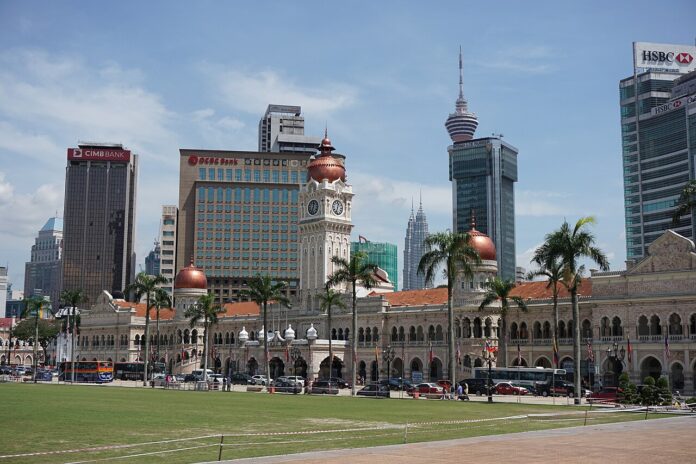
Opposite the square stands the Sultan Abdul Samad Building, completed in 1897 and once used by the colonial administration. Its red-brick façade, copper domes and clock tower remain among Kuala Lumpur’s most recognisable historic features.
Placing Citrawarna here is therefore more than a matter of convenience.
A festival celebrating the cultures of modern Malaysia will unfold in the space where colonial authority once staged its ceremonies and where the symbols of independence replaced it.
From a muddy confluence to a global city
Kuala Lumpur’s own name tells another story of transformation.
Kuala refers to a river mouth or confluence; lumpur means mud. The name is usually translated as “muddy confluence”, a reference to the meeting of the Klang and Gombak rivers, where a settlement linked to tin mining began to grow in the 19th century.
That settlement has become a capital defined internationally by the Petronas Twin Towers, Merdeka 118 and a rapidly changing skyline.
Yet the older city has not disappeared. Rivers, mosques, markets, colonial-era buildings and long-established Malay, Chinese and Indian neighbourhoods remain embedded between shopping districts, transport hubs and towers of glass.
This coexistence is the essence of Kuala Lumpur.
A visitor can move from the steel and geometry of KLCC to the food streets of Bukit Bintang, the shophouses of Chinatown and the historic buildings around Merdeka Square within a relatively compact part of the city.
During Citrawarna, that contrast becomes even sharper: modern towers on the horizon, a colonial-era square below, and performers carrying traditions from across Malaysia into the streets.
From festival to hotels, dining and further travel
An international media and travel-industry familiarisation programme will run alongside the festival from 23 to 27 July, extending the story beyond the performances at Merdeka Square.
The opening programme includes a tour of Imperial Lexis Kuala Lumpur, followed by a welcome meeting and dinner with the director-general of Tourism Malaysia.
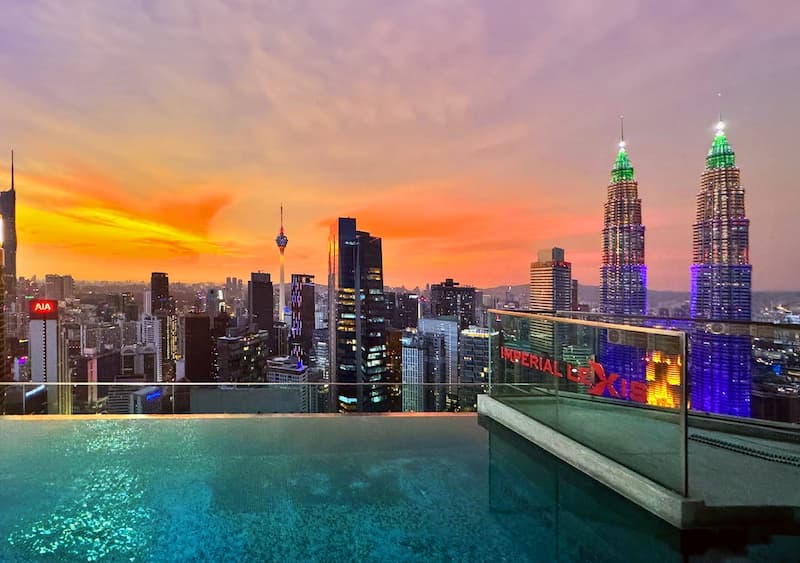
Imperial Lexis offers a different expression of the capital’s changing visitor economy. The 53-storey hotel combines high-rise city views with a resort-style experience in the centre of Kuala Lumpur.
Its upper floors look towards the Petronas Twin Towers, KL Tower and Merdeka 118, while the rooftop infinity pool and observation areas turn the skyline into part of the stay.
Private-pool accommodation is usually associated with beaches and island resorts. Here, that idea has been moved into one of Southeast Asia’s busiest capitals.
The contrast is characteristic of Kuala Lumpur: tropical leisure and dense urban life, heritage buildings and record-breaking towers, street food and high-rise hospitality.
A signature event for Visit Malaysia 2026
Citrawarna 2026 is one of the cultural showcases linked to Visit Malaysia 2026.
Rather than relying on one monument, one beach or one slogan, the event connects regional dance, music, food and craft with hotels, city experiences and further travel.
The aim is not simply to entertain visitors for a weekend. It is to make them curious about the wider country — and to encourage them to stay longer, return later and travel beyond Kuala Lumpur.
Malaysia rarely needs to shout.
It places its many colours before the visitor and allows curiosity to do the rest.
For one weekend in July, those colours will gather at Merdeka Square.
Citrawarna 2026 travel information
Dates: 24–26 July 2026
Venue: Dataran Merdeka, Kuala Lumpur
Admission: Free
Main event: Colours of Parade
Parade: 8pm on 25 July
Highlights: Traditional performance, regional food, arts and crafts, cultural activities and a 14-contingent night parade
여행레저신문 Copyrights ⓒ The Travel News. 무단전재 및 재배포 금지.