
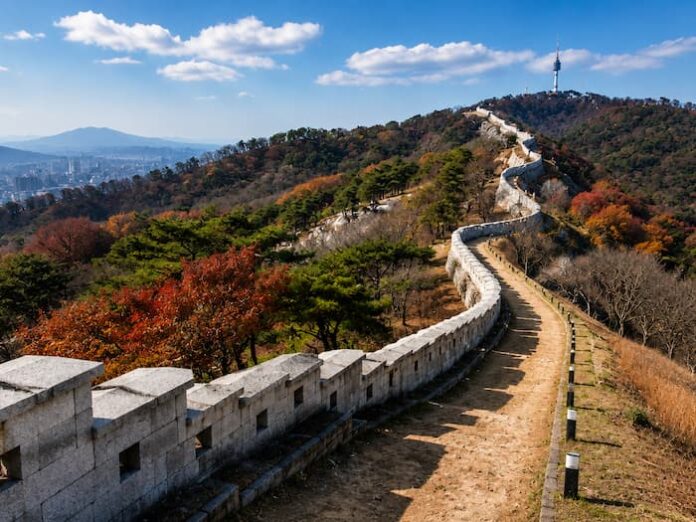
By Jungchan Lee, Publisher, The Travel News
Before the year came to an end, I wanted to walk the Seoul City Wall at least once. It was not only the beauty of the scenery that drew me there. More than anything, I wanted to feel, with my own steps, the way history and tradition still meet the present in this city with such quiet precision.
The Seoul City Wall, or Hanyangdoseong, was built around the old capital of Joseon. Rising to about ten meters in height and stretching for roughly eighteen kilometers, it once formed a protective ring around Hanyang. After founding the Joseon Dynasty, King Taejo ordered the wall to be built to defend the capital from external threats and to control movement in and out of the city. Later, during the reign of King Sejong in 1422, the wall was rebuilt in stone and reinforced with defensive facilities for archers and soldiers.
The old capital was entered through four great gates and four smaller gates. The four main gates were Heunginjimun, Donuimun, Sungnyemun and Sukjeongmun, each carrying the moral language of Confucian order. The four smaller gates included Hyehwamun, Souimun, Gwanghuimun and Changuimun. Today, some remain in form, while others survive only as memory and trace. Donuimun, Souimun and Gwanghuimun no longer stand as they once did. Their sites are all that remain.
Beginning at Hyehwamun
I began my slow walk at Hyehwamun, also known as the East Small Gate. The gate no longer stands at the center of movement as it once did. It does not open and close the life of the city. It simply remains, closed and still, holding its place in time.
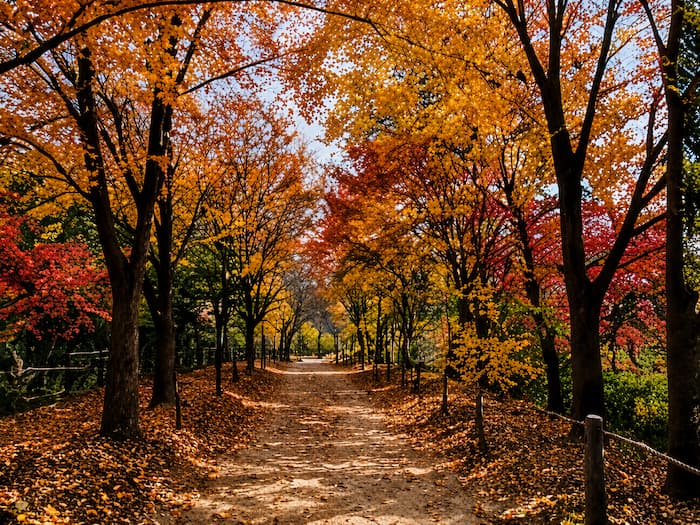
From Hyehwamun toward Seoul Science High School, the wall path was dressed in late autumn color. I had lived in Seoul for decades, yet I had not known that such beautiful foliage existed in this part of the city. The leaves, red and yellow, seemed to gather around the old stones as if the season itself had chosen the wall as its final stage.
At places, the path broke off and then resumed, revealing the way time has entered and left the city. Stones that had lost their companions long ago had found new partners after nearly a century. Old stone and new stone stood side by side, making visible the meeting of past and present. In that encounter, one could feel the value of long waiting. Across a thousand years, they had become part of the same road. Perhaps they were also promising to walk together into another thousand.
Autumn Toward Sukjeongmun
To the right of the wall path, Donam-dong and Seongbuk-dong followed along. Apartment blocks, houses and villas filled the urban slope below. The city, which had worn the fullness of summer green only months before, had now returned to its original gray. It was not a bleak gray, but the exposed color of the city when leaves have fallen and structures stand revealed.
The 2.5-kilometer walk to Malbawi Information Center is pleasant enough for almost anyone. It is just steep enough to bring small beads of sweat to the forehead, but never so hard that it loses the character of a walk. The path gives the body a mild challenge and gives the mind room to wander.
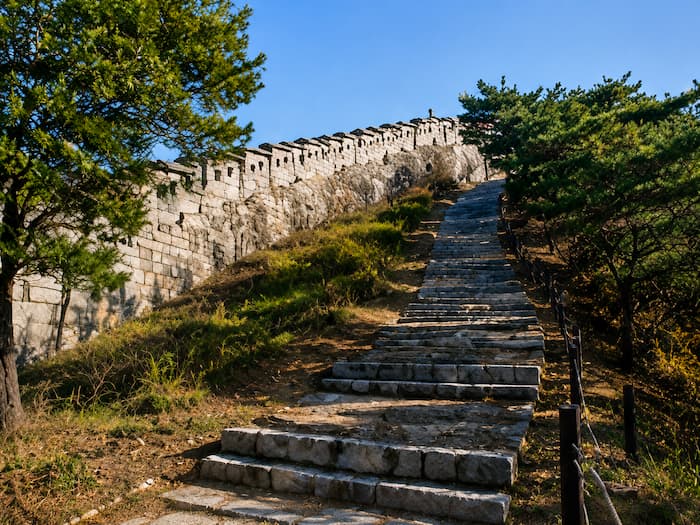
After registering at Malbawi Information Center, a climb of about 200 meters brings Sukjeongmun into view. Seoul’s northern gate, once the passageway for people coming from the northern Gyeonggi region into the capital, now opens wide to visitors. In the days of old Hanyang, many travelers must have passed through it, carrying news, goods, worries and hopes into the city.
Yet standing before the open gate today, one feels a strange irony. The gate is open, but the sense of passage has disappeared. The road is no longer simply a road. A father, old enough to carry the years in his posture, had his young son on his shoulders. He pointed here and there along the wall, teaching the child about the past. In that moment, the path seemed to carry time from the father to the child. The wall was not only stone. It was inheritance.
Cheongundae, Bugak and the Thought of Division
About 1.2 kilometers from Sukjeongmun lies Cheongundae. From there, Seoul can be seen at a glance. On a clear day, it must be one of the finest places to understand the shape of the capital. On the day I walked, visibility was poor, and the city would not fully enter the camera. Still, even through the haze, one could sense why people recommend returning on a clear day. Seoul was there, partly hidden, partly revealed, waiting for another visit.
Leaving Cheongundae behind, I hurried toward Changuimun, the northwestern small gate. I had begun late in the afternoon, and there was a time limit to consider. Some sections of the Seoul City Wall require registration and are closed after certain hours. A walk that begins as leisure soon reminds the traveler that this is also a protected historic and security zone.
At Bugak Shelter, I stopped for a moment. The wind was cool. My hurried steps slowed, and I stood thinking. A fortress wall, by its nature, is not an object of communication. It is a structure of separation. It was built to divide inside from outside, friend from stranger, the protected from the threatening. But in the twenty-first century, in an age that speaks endlessly of communication, the Seoul City Wall still carried another kind of division.
The thought made my heart heavy.
A wall built to protect Hanyang from thieves, invaders and uncontrolled entry had become, in another age, a symbol of a different kind of separation — one that divided a nation and its people. The stones did not say this aloud. They simply stood there. But walking beside them, it was impossible not to feel how history continues to change the meaning of things.
 Down Toward Changuimun
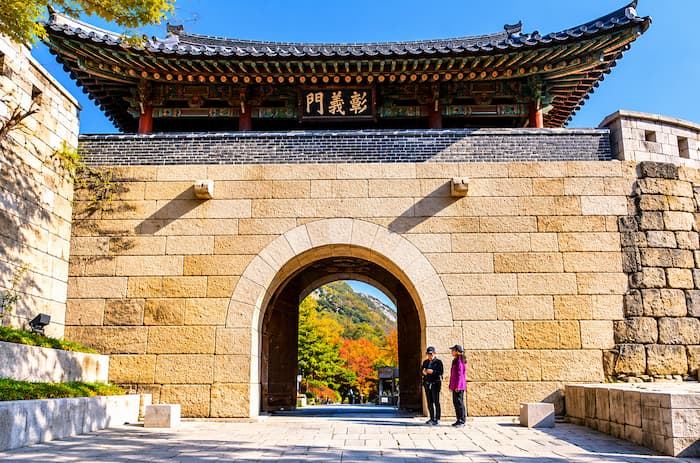
The path from Bugak Shelter to Changuimun is a steep descent of stone steps. I had chosen the route beginning from Changuimun in order to face the famous 983 steps. Perhaps it was, in the end, a desire to taste the small sense of achievement that comes after a hard road.
Below, Buam-dong appeared, the neighborhood people say moves at Seoul’s slowest pace. Then came a view of Gugi-dong, where persimmon trees and maples stood thick with late-season color. Before long, Changuimun was there.
It was time to stop walking.
Far ahead, another traveler continued along a different road, his back turned toward the next stretch of the journey. I stood watching for a moment. The city had not disappeared. The wall had not ended. Only my walk for the day had come to a close.
An Older Rhythm Beneath the Modern City
The Seoul City Wall is not merely a walking trail. It is a place where the city’s landscape, its memory and its unfinished questions meet. To those who have lived in Seoul for many years, it can still feel unexpectedly new. To those who visit for the first time, it offers a way of seeing the capital beyond traffic, buildings and speed.
Stone, forest, gate and stairway remain. People continue to pass. And along the old line of Hanyangdoseong, Seoul still keeps an older rhythm beneath the surface of the modern city.
여행레저신문 Copyrights ⓒ The Travel News. 무단전재 및 재배포 금지.