김미래 기자 ㅣ 여행레저신문
When Yobani Velásquez Quintero, Colombia’s ambassador to South Korea, stepped onto the dance floor, the audience expected a brief diplomatic greeting. What followed was a five-minute salsa performance.
Phones rose across the room as the ambassador moved through the music with controlled footwork and the ease of someone familiar with the stage. He was performing after Ensalsate, the acclaimed salsa company from Cali, yet the transition did not diminish the reaction from the crowd.
“You were the best dancer tonight,” this reporter told him when the music ended.
The ambassador smiled.
“I used to be a dancer,” he replied.
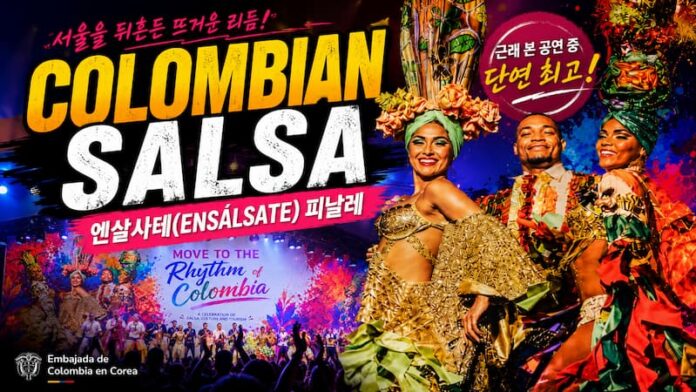
The exchange captured the character of “Move to the Rhythm of Colombia,” held July 11 at Gavin Art Hall in Seoul. Organized jointly by the Embassy of Colombia and ProColombia, the event did not rely on a conventional presentation of landmarks, itineraries or tour products. It placed Colombian culture in front of the audience and invited them to take part in it.
Music, performance and participation carried the message. The ambassador danced, artists from Cali performed, and hundreds of guests moved from a salsa workshop to a staged production and then to social dancing. Colombia was presented not as a list of places to visit, but as an experience with a recognizable rhythm and human presence.
Colombia’s ambassador to South Korea, Yobani Velásquez Quintero, stepped onto the dance floor
More Than an Audience of 400
About 400 participants were invited to the event. With performers, diplomats, officials, media representatives, influencers and operating staff included, the total number of people at the venue approached 500.
The scale mattered, but the composition of the audience mattered more. Those attending were not a randomly assembled public crowd. They came from different professions, age groups and social circles, but shared an interest in salsa or Latin American culture. Many were active within dance communities or maintained their own social media networks.
That made them a particularly relevant audience for Colombian tourism. They may not yet have purchased a trip to Colombia, but they already had a cultural reason to consider one.
The venue also bore little resemblance to a standard tourism presentation. Guests were not seated through a succession of destination slides. They learned basic steps, watched professional dancers from Cali and later returned to the floor themselves.
The design allowed Colombia to communicate through participation. By the end of the evening, many guests had generated their own photographs and videos, creating material likely to travel through personal networks well beyond the hall.
Cali as the Point of Entry
Colombia could have attempted to introduce Bogotá, Cartagena, Medellín, the Coffee Cultural Landscape and several other destinations in a single program. Instead, the organizers concentrated on Cali and salsa.
The choice gave the event a clear identity.
Cali, the capital of the Valle del Cauca department in southwestern Colombia, is promoted internationally as the “World Capital of Salsa.” The distinction reflects more than the city’s clubs and performances. Salsa has become embedded in its festivals, dance schools, professional productions, neighborhood culture and tourism economy.
For people already interested in salsa, Cali requires little abstract explanation. It is a destination linked directly to a personal passion.
That makes the city an effective entry point into a much larger country. A traveler inspired to visit Cali is likely to connect through Bogotá or combine the trip with other Colombian destinations. A focused cultural proposition can therefore generate interest extending well beyond the city used to introduce it.
The event’s strength came partly from that restraint. Rather than attempting to sell every aspect of Colombia at once, it gave the audience one compelling reason to begin thinking about the country.
Ensalsate Turns a City Into a Live Performance
Ensalsate occupied the center of the evening’s professional program.
The Cali-based production combines salsa with other dance traditions and integrates choreography, music, costume and theatrical staging. Its Seoul performers brought the speed and precision associated with the Cali style, moving through tightly synchronized sequences, rapid footwork and technically demanding lifts.
Their expressions were as important as their athleticism. The dancers maintained a visible sense of enjoyment even through the most physically exacting passages, allowing the performance to remain accessible rather than merely demonstrative.
For the audience, the result was more than an imported stage show. Ensalsate compressed several dimensions of Cali into a single performance: its dance culture, training system, creative economy and ability to turn salsa into a professional cultural product.
Ensalsate carried that ecosystem onto a Seoul stage. The company was both an artistic attraction and an invitation to see the place that produced it.
[Video: Ensalsate performs in Seoul]
Seven Hours of Participation
The program began with a salsa workshop lasting about an hour.
Participants followed instructors across the floor, learning basic movements and working with partners instead of listening to a lecture about Colombian tourism. The session was not designed to produce accomplished dancers. Its value lay in removing the distance between audience and culture.
After the workshop, guests temporarily left the main room while the venue was reconfigured. A stage was installed on the same floor, transforming the workshop area into a professional performance space. Following Ensalsate’s appearance, the room changed again as participants returned for social dancing.
The progression was deliberate. Guests first learned, then watched and finally joined one another on the floor.
As the evening advanced, the distinction between performance and participation became less rigid. People who had initially recorded the dancers from the edge of the room moved into the center when the social session began.
Colombian culture was no longer something being displayed to them. It had become the structure of the evening itself.
Air Tickets Connect the Experience to Travel
A digital roulette draw projected on a large screen added another layer of audience involvement.
Rather than announcing winning numbers through a routine presentation, organizers used the screen to build collective anticipation. Guests watched the draw together, extending the event’s participatory character beyond the dance floor.
Qatar Airways, an official sponsor, provided three tickets for travel from Incheon through Doha to Bogotá.
The prizes carried practical and symbolic value. Participants who had encountered Colombia through music and movement were given a direct opportunity to travel to the country itself. The transition from cultural interest to a potential journey was built into the program rather than presented as a separate sales message.
It was a simple but effective connection: experience Colombia in Seoul, then travel to see it firsthand.
ProColombia’s Team Manages a Complex Event
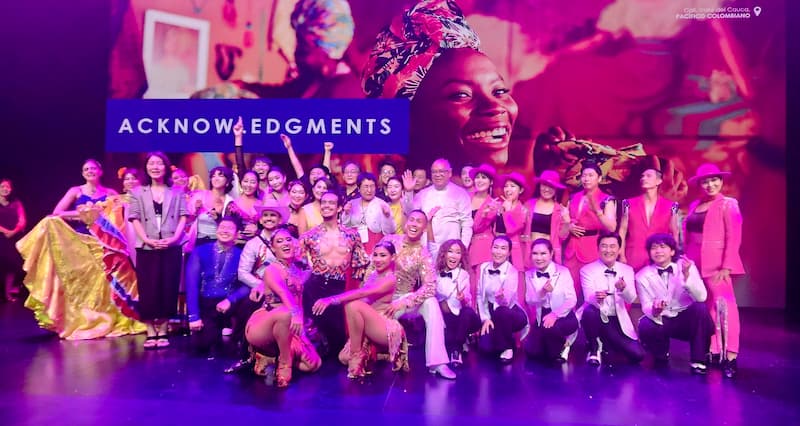
The evening also demonstrated the operating capacity of ProColombia’s Korea team, led by Country Director Shirley Vega.
ProColombia is responsible for promoting international tourism, foreign investment, non-mining and energy exports, and Colombia’s national image. It works through a network of domestic and international offices to support market development and international business opportunities.
In Seoul, its team managed a participant mix that included diplomats, senior guests, media professionals, influencers, performers and several hundred members of the public.
The work was visible in the details. Invitations and responses were organized in advance, guest categories were clearly distinguished, and seating was arranged according to the different functions of diplomatic representatives, media and other participants. Staff coordinated admissions, movement through the venue and the rapid conversion of the main room between workshop and performance formats.
Vega moved continuously through the event, communicating in Korean, English and Spanish as she connected Korean guests with diplomats, artists and Colombian representatives. Her role went beyond delivering formal remarks. She was engaged in the practical operation of the event and in direct conversation with participants.
The wider team showed similar discipline. Staff members wearing circular identification badges greeted guests first, answered questions promptly and escorted participants when directions alone were insufficient. The service appeared prepared rather than improvised.
That level of coordination was significant because the event brought together groups with very different requirements. Diplomatic protocol, media access, performance logistics and public participation had to function simultaneously in a venue undergoing repeated physical changes.
Despite the size and complexity of the program, major confusion was not evident.
Shirley Vega, ProColombia’s Korea country director, discusses the purpose of the event and Colombia’s tourism strategy
Culture Before the Sales Pitch
“Move to the Rhythm of Colombia” was first and foremost a Colombian cultural tourism event. Its performances, workshop and social program gave participants an immediate encounter with the country’s identity.
The program also illustrated a broader change in destination marketing.
Traditional tourism roadshows often begin with the travel trade. Airlines, tour operators and agencies are invited to hear about a destination, consider product development and eventually present it to consumers.
Colombia followed a different sequence in Seoul. It began with people already predisposed to respond to one of the country’s strongest cultural assets.
The organizers did not gather 400 business cards from industry professionals. They assembled more than 400 people with a reason to care about Cali. By giving them material worth recording and sharing, the event also turned participants into distributors of their own experience.
A photograph, a short video or a personal account posted by a trusted member of a dance community can carry a different kind of influence from an institutional advertisement. It enters an existing network through genuine interest rather than paid placement.
This does not eliminate the need for airlines, tour operators or distribution partners. Colombia remains a long-haul destination from South Korea, and converting interest into arrivals requires routes, pricing, itineraries and reliable travel products.
But in a market increasingly shaped by independent travelers, demand does not always begin with a brochure or sales call. It can begin with a cultural connection strong enough to make someone search for a city, follow an airline route or imagine a future journey.
A Tourism Message Delivered in Motion
The most memorable elements of the evening were also its most direct.
Artists from Cali performed at full intensity. Hundreds of participants learned and danced together. The ambassador stepped onto the floor rather than remaining behind a podium. ProColombia’s team managed the movement of people, languages and program elements with close attention to detail.
The event did not ask participants to imagine Colombia solely through photographs or promotional language. It gave them a limited but tangible encounter with the country’s cultural energy.
That distinction matters.
Travel products may be assembled by airlines and tour operators, but the decision to travel often begins earlier, when a destination becomes personally meaningful.
In Seoul, Colombia found that point of connection in salsa—and allowed the rhythm to make the case.
여행레저신문 Copyrights ⓒ The Travel News. 무단전재 및 재배포 금지.