
이가온 기자 ㅣ 여행레저신문
The Seoul International Travel Fair is changing. For many years, international travel fairs in Korea were mainly seen as promotional exhibitions. Tourism boards decorated their booths, local governments presented regional attractions, airlines introduced routes, hotels shared brochures, and visitors collected travel information. That function remains important. But SITF 2026 showed that the role of a travel fair is becoming broader and more business-oriented.
Held from June 4 to 7 at COEX Hall C in Seoul, the 41st Seoul International Travel Fair reflected the changing structure of Korea’s outbound travel market. Korean travelers are now more independent, more digital and more selective. They search, compare, book and design their own journeys through online platforms, mobile apps, blogs, video channels, news articles and social media. At the same time, travel agencies are being asked to play a more consultative role, especially for destinations that require deeper explanation and careful itinerary design.
In this environment, an international travel fair can no longer be understood only as a place for destination promotion. It is becoming a place where markets are tested, partnerships are built, content is created and product possibilities are discussed. SITF 2026 showed that this transition is already taking place.
 From promotional booths to business consultation
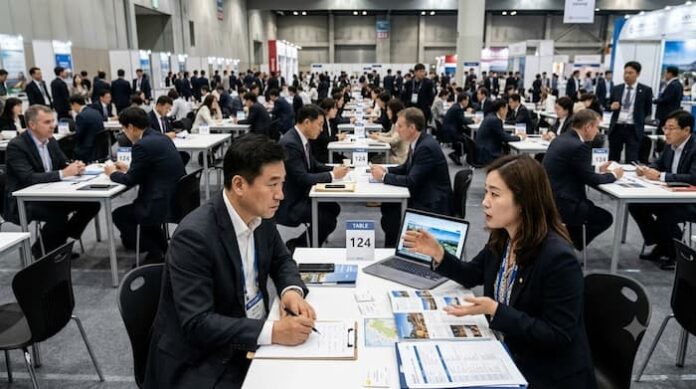
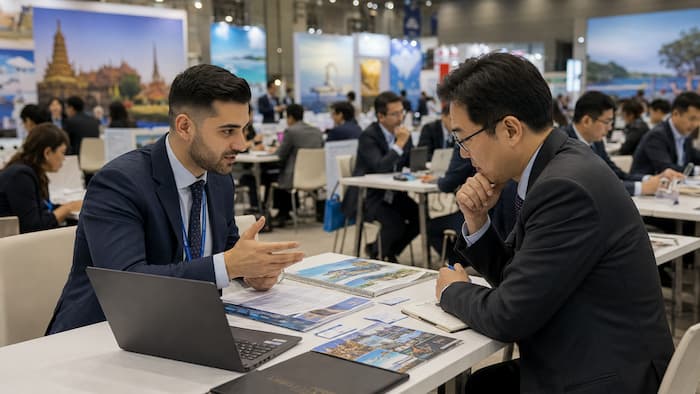
One of the clearest signs of change at SITF 2026 was the stronger role of B2B consultation. Inside the exhibition hall, overseas tourism boards, DMCs, airlines, hotels, local governments and Korean travel professionals met at consultation tables to discuss real business possibilities. The conversation was no longer limited to destination images or general introductions. It moved toward more practical questions: how a destination can be sold in Korea, which traveler segment it fits, how air access should be explained, and what kind of follow-up can be created after the fair.
This is an important shift. In the past, the success of a travel fair was often judged by booth size, visitor traffic and visual impact. These elements still matter, but they are not enough by themselves. In today’s Korean travel market, the quality of meetings and the possibility of follow-up are becoming more important.
Destinations such as Bhutan, Tanzania, Georgia, Tunisia, Egypt, Greece, Indonesia, Hong Kong, Poland, Hungary and Hengqin all showed interest in reconnecting with the Korean market. Their common challenge is clear. They need to explain why Korean travelers should consider them now, what type of customer they are suitable for, how the trip can be structured, and which Korean partners can help turn interest into actual products.
The real value begins after the fair
The value of an international travel fair is not decided only during the event. Opening ceremonies, booth design and visitor numbers all have meaning. But the real value begins after the fair ends. Did a meeting lead to a product discussion? Did an interview become an article? Did a tourism board prepare Korean-language follow-up material? Did a DMC provide usable itineraries, images and sales information? Did the destination remain visible in the Korean market after the booths were dismantled?
In the past, many travel fairs ended when the exhibition hall closed. Brochures were packed away, name cards were collected, and follow-up often depended on individual effort. The market has changed. Korean travelers search and compare continuously. Korean travel agencies need information that can be used immediately. Tourism boards and DMCs need articles, newsletters, product materials, images, consultation channels, familiarization trips and follow-up meetings.
This is where SITF 2026 showed its strongest possibility. When meetings at the fair are connected to interviews, online daily coverage, newsletters and post-event product development, the fair becomes more than an exhibition. It becomes a platform that leaves a trace in the market.
Why online daily coverage matters
Another important point from SITF 2026 was the growing value of online content. A physical exhibition hall has limits. Not every travel agency can attend. Not every regional partner can visit Seoul during the event. Overseas headquarters, DMCs, hotels and consumers may not be able to see what happened on site. Online daily coverage, seller interviews and editorial articles extend the reach of the fair beyond the exhibition hall.
A seller interview is not just a promotional message. It shows how a destination sees Korea, what kind of partner it is looking for, what products it wants to develop, and what message it wants to deliver to Korean travelers. For tourism boards and DMCs, this type of content can also function as a market test. It helps them understand which messages may work in Korea and which areas need clearer explanation.
The future of an international travel fair lies in the connection between offline meetings and online memory. The booth is where the relationship begins. The online daily is where the message remains. Business meetings are the starting point. Articles and newsletters are the records that continue to work after the event.
The FIT era changes the role of travel fairs
The Korean travel market has moved strongly toward FIT behavior. Consumers search for flights directly, compare hotels, book local activities through apps and judge destinations through blogs, YouTube, news articles, social media and peer recommendations. In this environment, a travel fair cannot rely only on traditional trade promotion.
But this does not mean that travel agencies have lost their importance. In fact, for destinations that require explanation, the role of the travel trade becomes even more important. Bhutan, Tanzania, Georgia, Tunisia and Egypt are not always self-explanatory destinations for Korean consumers. They require information on access, safety, seasonality, itinerary design, cost, local handling and the right traveler segment.
This means the future travel fair must serve both B2B and B2C needs. It must support trade consultation, destination discovery, media coverage, consumer awareness, online search visibility and post-event sales consultation. A fair should not simply display destinations. It should help build a market.
What tourism boards and DMCs should prepare
SITF 2026 also delivered a practical message to overseas tourism boards and DMCs. Coming to Korea with a booth and brochures is no longer enough. Korean-language material, air access information, sample itineraries, target segments, price logic, images, captions, trade sales tools, consumer stories and post-event follow-up plans should be prepared together.
This is especially important in the FIT and AX-AI era. Korean travelers may use search and AI tools to explore travel ideas, but AI cannot create reliable travel products from missing or outdated information. Hotels, restaurants, transport providers, attractions, shows, local tours, DMCs and tourism boards must first prepare accurate and updated information. Without supplier readiness, AI travel planning can become confusing rather than helpful.
The message is simple. Korea should not be treated as a short-term event market. It should be treated as a continuous media, content and product market. One exhibition is valuable, but what happens after the exhibition is just as important.
Travel News Market View
SITF 2026 reaffirmed the field strength and network that the Seoul International Travel Fair has built over many years. Tourism boards, local governments, airlines, hotels, DMCs and travel agencies gathered in one place, and the interest of overseas destinations in the Korean travel market remained clear. The exhibition hall served not only as a promotional space, but also as a business venue where real conversations and relationships were formed.
In that sense, SITF 2026 can be regarded as a successful fair. There is still room for improvement, of course. Buyer management, seller directories, post-event consultation and online daily operation can be refined further. But the important point is that the fair reconnected the Korean travel market with overseas tourism players and created practical opportunities for dialogue, consultation and follow-up cooperation.
In particular, B2B consultation, seller interviews, online daily coverage and newsletter expansion showed that the Seoul International Travel Fair can take on a wider role in the years ahead. If the event continues beyond the exhibition hall through editorial content, product discussions and follow-up meetings, SITF can become an even more important platform in Korea’s tourism business market.
The Seoul International Travel Fair already has a long history. Now, online content, B2B consultation, market data and product development functions are being added to that foundation. SITF 2026 was meaningful because it showed this direction. If this flow becomes more systematic, the Seoul International Travel Fair can grow further as a leading platform that reads the Korean travel market, connects overseas destinations with Korean partners, and helps shape the next stage of tourism business in Korea.
여행레저신문 Copyrights ⓒ The Travel News. 무단전재 및 재배포 금지.