
이만재 기자 ㅣ 여행레저신문
Korea’s Travel Recovery Is No Longer Just About Arrivals
Inbound visitors crossed 10 million earlier than last year, foreign card spending passed the 2 trillion won mark, and lower July fuel surcharges are reopening outbound demand. The harder question now is where the money lands.
2026-07-01The Travel NewsKorea’s travel market has entered a more demanding phase of recovery. The headline figures are strong. Inbound arrivals have passed 10 million earlier than last year. Foreign visitors’ domestic card spending has crossed the 2 trillion won mark for the first time on a monthly basis.
Outbound demand is also responding to lower July fuel surcharges.But the market is no longer explained by one recovery line. Visitors are spending in more specific categories, Korean outbound travelers are still watching total trip costs, and regional airports, hotels, cruise operators and MICE suppliers are all competing to capture the next layer of demand.
The easier story is that travel is back. The more useful story is that travel money is moving unevenly.Korea is not only counting arrivals anymore. It has to read spending, access, distribution and conversion. The market is active, but it is not loose. It rewards the sectors that can turn movement into revenue.
The headline number is back
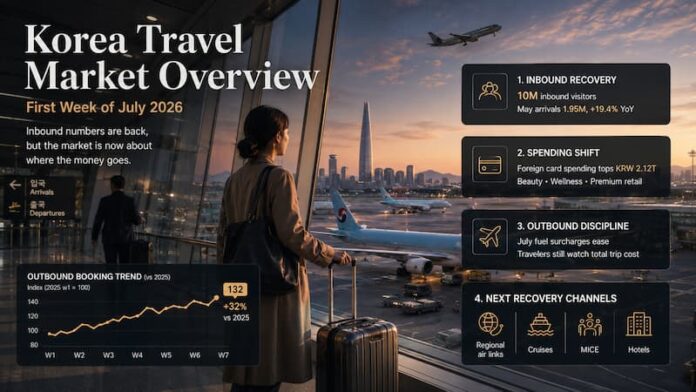
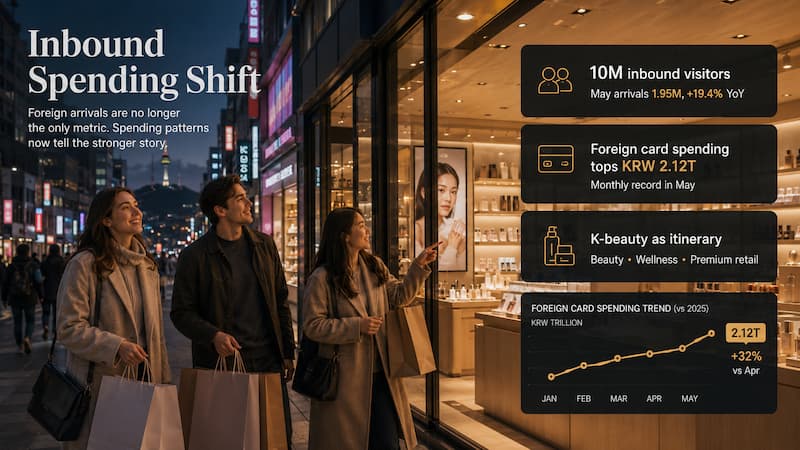
The Ministry of Culture, Sports and Tourism said Korea had surpassed 10 million inbound foreign visitors on a provisional basis as of June 20, about a month earlier than last year. May alone brought about 1.95 million inbound visitors, up 19.4 percent from a year earlier.
That number matters because it confirms the return of scale. Yet scale is no longer enough as a market diagnosis. The next question is whether visitors stay longer, spend more widely and move beyond the most familiar urban districts.
The recovery of arrivals is the entrance. The real market story begins after the traveler lands.For Korea, the strategic issue is not simply how many foreign visitors arrive. It is where they sleep, where they shop, which services they book, which regions they visit and how much of that spending remains in the local tourism economy.
Foreign spending is now the stronger indicator
The stronger number may be spending. Korea Tourism Organization data showed that foreign visitors’ domestic card spending reached 2.1222 trillion won in May, the first time monthly foreign card spending had exceeded 2 trillion won. The figure was up 67.1 percent from a year earlier.This changes the tone of the inbound discussion.
Korea is not only receiving visitors again. It is beginning to see the spending map behind them.The categories are also shifting. Premium pharmacies, skincare clinics, lifestyle fashion, character goods, luxury shopping and beauty-related services are gaining weight.
That means the foreign visitor economy is no longer confined to airport duty-free, group shopping or a few famous retail streets.The visitor is becoming more specific. So is the money.This is why the next phase of inbound tourism will depend less on broad slogans and more on product design.
A visitor who comes for beauty, wellness, fashion, food, culture or fandom does not move randomly. That visitor follows an itinerary. The question is who builds that itinerary and who receives the spending along the route.
K-beauty is moving from retail shelves into travel itineraries
K-beauty is now one of the clearest examples of this shift. The 2026 Korea Beauty Festival opened on June 24, with its main HiKR Ground programs running through July 19 and global OTA-linked special promotions continuing through September 30.
The program connects K-beauty, wellness, lifestyle experiences, travel products and business meetings, showing how beauty demand is being pulled into the tourism market.
The point is not that foreign visitors buy Korean cosmetics. That has been true for years. The newer point is that beauty is becoming a reason to travel.Skincare, personal color consulting, hair, makeup, wellness, medical beauty and lifestyle shopping are being packaged into travel behavior.
K-beauty is moving from a product category into an itinerary category. That is a significant change for inbound tourism.A cosmetic purchase ends at the counter. A beauty itinerary can involve flights, hotels, clinics, shopping districts, restaurants, local transport, interpreters, reservation platforms and repeat visits.For Korea, this is where consumer goods, urban tourism and service exports begin to overlap. The country is not simply selling a product. It is selling the experience around the product.
Outbound demand is moving, but with a calculator in hand
The outbound market is also active, but it remains disciplined. Korean Air’s July fuel surcharges for Korea-origin international flights fell to 46,400 won at the lowest band and 344,000 won at the highest band, down from June’s range of 61,500 won to 451,500 won.
The July surcharge level applies from July 1 to 31.That decline has helped reopen the booking conversation. Modetour reported that overseas travel bookings from June 15 to 19 rose by about 32 percent compared with the same period in the previous week.
Southeast Asia showed notable increases, with Indonesia up 62 percent and Vietnam up 38 percent, while Europe also drew attention as a long-haul region benefiting from lower surcharge pressure.But fuel relief does not remove every cost concern. The won-dollar exchange rate has remained elevated, keeping overseas accommodation, local spending, shopping and dining costs under pressure.
That is why the outbound market should not be read as a simple rebound. Korean travelers are not refusing to travel. They are refusing uncertainty.A lower fuel surcharge can restart interest. It does not automatically close the sale. Travelers still compare exchange rates, total airfare, hotel prices, local costs, included meals, optional tours, tips, cancellation terms and the reliability of the itinerary.The winning product is not always the cheapest product. It is the product whose final cost can be understood before departure.
Short-haul still has the advantage of visible cost
Short-haul destinations continue to convert first because the total cost is easier to see. Japan, China, Vietnam, Taiwan, Hong Kong and Southeast Asia offer shorter flight times, more familiar price ranges and easier comparison across airlines, hotels, packages and online channels.
This visibility is now a product advantage.During a high-cost travel cycle, travelers prefer destinations where uncertainty feels limited. A nearby trip may still be expensive during peak season, but the possible cost overrun feels narrower.
That is why short-haul travel often responds first when fuel surcharges fall or vacation timing improves.For tourism boards, proximity alone is no longer enough. Nearby destinations still need fresh reasons to book: family resorts, cool-weather escapes, regional food routes, festivals, wellness stays, shopping themes, repeat-visitor itineraries and clearer local cost guidance.
The Korean traveler is not only asking, “Where can I go?”The sharper question is, “Can I understand the whole cost before I go?”
Regional airports are back in the recovery equation
Regional air access is becoming part of the market story again. Korea Airports Corporation and Shanghai Airport Group recently moved to strengthen cooperation on routes between Shanghai and Korean regional airports.
Passenger demand on Shanghai routes through regional airports such as Gimpo, Gimhae, Jeju and Cheongju increased from 920,000 passengers in 2023 to 2.2 million in 2025, about 2.4 times higher.This is not only an aviation issue.
It is a tourism distribution issue.If inbound recovery remains concentrated through a few metropolitan gateways, regional tourism will continue to struggle with uneven benefits. But if regional airports can secure stronger links with China, Japan, Taiwan and Southeast Asia, the spending map can widen.
Air access does not guarantee regional tourism. But without air access, regional tourism starts with a handicap.The next question is whether local governments, airports, hotels, DMCs and travel agencies can build products around these routes. A flight creates the door. The destination still needs the reason to enter.
 Incentive travel is returning through ports
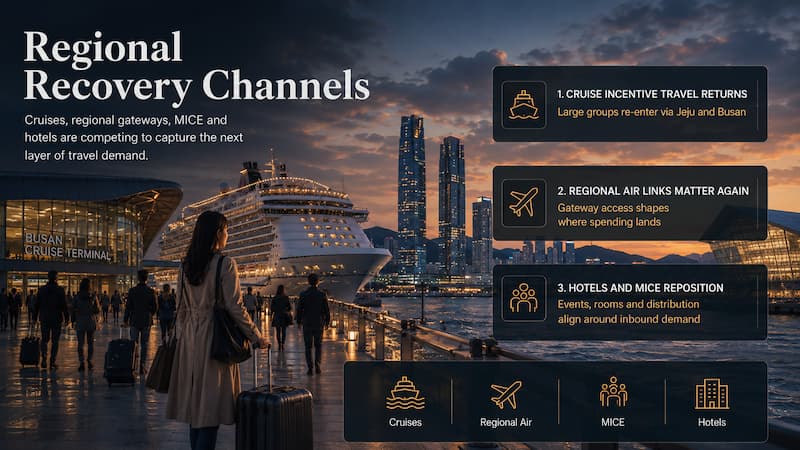
Cruise and incentive travel offered another important market clue. Korea Tourism Organization secured a large incentive group of about 5,000 employees and distributors from China’s Wuliangye Group.
The group is visiting in two waves of about 2,500 people each, using Adora Cruises from Shanghai to Jeju and Busan between June 25 and July 3.This is a meaningful development because it brings together several markets at once: China incentive travel, cruise tourism, regional ports, Jeju, Busan and local consumption.Before the pandemic, Chinese incentive groups were often measured by scale.
In 2026, the more important point is structure. The Wuliangye movement is not only a large group arrival. It shows that corporate incentive travel can return through maritime routes and reach regional economies without relying only on airport-based movement.Ports matter again.
Cruise terminals matter again. Ground handling, local meals, shopping districts, shore excursions and city hospitality matter again.For Jeju and Busan, the opportunity is not only welcoming passengers. It is converting a short port call into measurable local value.
MICE and K-culture are becoming one platform
The MICE market is also widening beyond conventional meetings. MyK FESTA 2026 was held from June 25 to 28 at KINTEX and Sono Calm Goyang, bringing together K-culture categories including beauty, fashion, food, performances, exhibitions and business programs.
This is where K-culture becomes more than entertainment. A K-pop concert can bring attention. A festival can bring visitors. But when exhibitions, pop-ups, export consultations, tourism promotion and buyer meetings are placed around the same event, culture becomes a business platform.
For Korea, this is one of the strongest future directions in inbound tourism. K-content is already global. The task is to turn that attention into structured travel, B2B meetings, product sales, regional visits and repeat demand.The old boundary between culture, tourism and exports is weakening. That is good news for Korea, but only if the industry can package the movement properly.
Hotels are reading recovery through space and distribution
The hotel market is also adjusting to the return of foreign visitors. In Myeongdong, the Japanese capsule-style hotel brand First Cabin is entering Noon Square, with the seventh floor of the retail complex converted into accommodation space.
The property held a pre-opening on June 26 and is scheduled for formal operation in July.This is more than a hotel opening. It shows how inbound recovery can reshape urban real estate.
Myeongdong is one of Korea’s most visible inbound districts. If foreign independent travelers return and accommodation demand strengthens, commercial buildings begin to look again at hospitality use. Retail space, lodging, food, beauty and transport start to form one visitor economy.Hotels are not simply waiting for guests.
They are adjusting space, room types, operating models, channel strategy and pricing around the changing visitor.At the same time, hotel distribution is becoming more technical. OTA relationships, channel managers, revenue management and direct sales strategy are no longer back-office subjects.
They shape whether a property can convert demand into profitable occupancy.A full room is not always a profitable room. The hotel question in 2026 is not only occupancy. It is margin, channel control and customer mix.
Regional tourism needs more than promotion
Regional tourism remains the unresolved test. Yanolja Research released its first Korea Tourism City Competitiveness Index, analyzing 255 administrative districts and more than 29,000 tourism sites through social big data. Seoul’s Songpa-gu ranked first overall, while Busan’s Suyeong-gu ranked first in attractiveness.
The ranking itself is useful, but the deeper point is strategic. Regional tourism cannot rely on visibility alone. It needs data, access, products, accommodation, local spending routes and repeatable distribution.
KITS 2026, the Korea International Tourism Show, will be held from July 3 to 5 at KINTEX with around 300 participating organizations and about 500 booths expected.
The event is also expected to include B2B buyer meetings and tourism industry networking programs.Events like this can help, but only if they move beyond display. Korea already has destinations. It has festivals.
It has local stories. What remains weaker is the commercial chain that turns those assets into bookable, sellable and repeatable travel products.The regional tourism question is therefore blunt: can recovery money leave the most familiar districts?
The Travel News Market View
The first week of July does not show a weak Korean travel market. It shows a market that has moved beyond simple recovery and entered a more selective phase.The demand is visible.
Inbound volume is back, foreign spending has crossed a new threshold, outbound demand is reacting to lower fuel surcharges, and China-related traffic is returning through both airports and ports. K-beauty, K-culture, hotels, regional airports, cruise operators and MICE suppliers are all finding new openings.
But those signals do not mean that every part of the market is recovering with the same strength.The real issue is conversion.Korea’s travel market now has to prove that movement can become value.
Arrivals must become spending. Spending must move beyond a few familiar districts. Air routes must become regional products. Events must become repeatable business. Hotel demand must become margin.
Outbound products must make total cost clear before travelers commit.This is not a market where exposure alone will be enough. Airlines need more than seats. Travel agencies need more than low prices.
Hotels need more than occupancy. Tourism boards need more than awareness. Regional destinations need more than promotion.The winners in the second half of 2026 will be the players that control the itinerary, reduce uncertainty and keep more value inside the travel chain.
Korea has regained movement. The next stage will judge structure.
The question is no longer whether people are moving. They are.
The question is where the money lands, who captures it, and whether Korea can turn recovery into a broader tourism economy rather than a temporary rebound.
여행레저신문 Copyrights ⓒ The Travel News. 무단전재 및 재배포 금지.