이만재 기자 ㅣ 여행레저신문
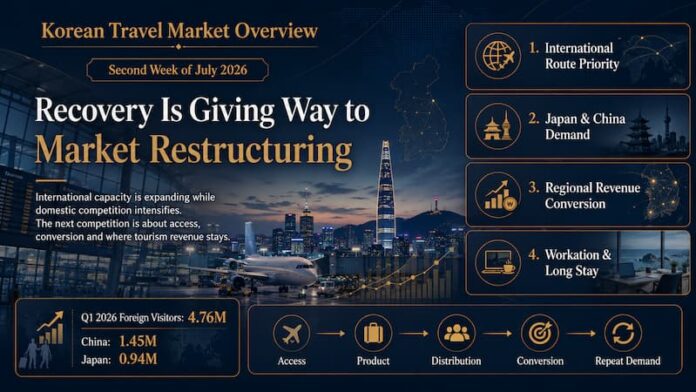
International capacity is expanding as airlines place greater weight on overseas routes, while domestic aviation faces stronger competition from rail and road transport. Japan and China remain central to short-haul demand, but passenger growth alone no longer explains the direction of Korea’s travel economy. The next stage of competition will be determined by who can turn access and visitor movement into sustainable revenue.
Korea’s travel market has moved beyond the simple recovery narrative that dominated the years immediately following the pandemic. International flight capacity continues to expand, inbound visitor numbers are rising and Korean travellers remain highly active in overseas markets. Behind those headline indicators, however, the structure of the industry is changing. Airlines are reallocating capacity, regional airports are struggling to turn new routes into stable demand, and travel companies are being judged less by passenger volume than by their ability to protect margins.
The first stage of recovery was largely about reopening borders and restoring suspended flights. The next stage will determine which airlines, airports, destinations, hotels and travel businesses can convert that restored movement into sustainable revenue. Korea’s travel market is therefore not returning to its previous form. It is being reorganised around profitability, connectivity and the quality of demand.
International routes take priority as domestic aviation loses ground
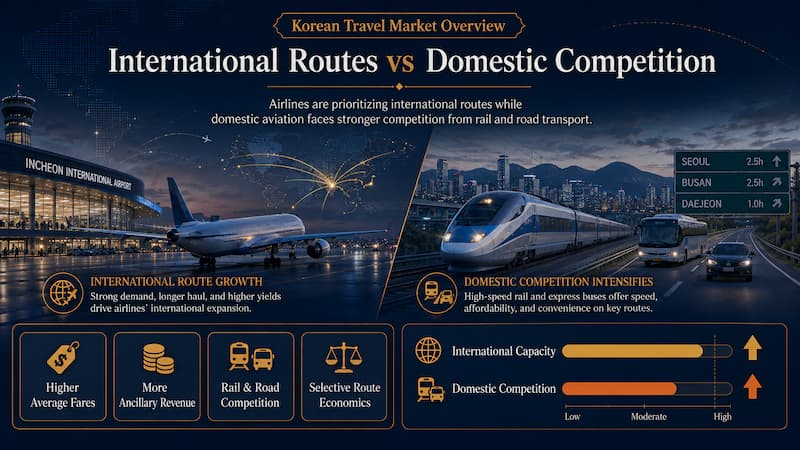
Korean airlines are placing greater emphasis on international services, where demand and revenue opportunities are generally stronger than in the domestic market. Overseas routes offer higher average fares, a broader destination portfolio and additional income from baggage, seat selection and connecting passengers. Airlines can also differentiate their products through network strength, departure times, partnerships and onward connections, giving international routes greater commercial flexibility.
Domestic aviation faces a more difficult operating environment. High-speed rail, express buses and private vehicles compete directly with short domestic flights, particularly on routes connected to Seoul. Travellers increasingly compare the total time and cost of a journey, including airport access, check-in, security procedures and ground transportation, rather than considering flight time alone. As a result, an increase in overall travel demand does not necessarily benefit every domestic route.
The central question for airlines is no longer simply whether passenger numbers are rising. It is where aircraft and seats can generate the strongest return. Korea’s aviation market is becoming more international, but it is also becoming more selective. Routes that cannot maintain sufficient fares, stable load factors and repeat demand will remain under pressure even when the wider travel market continues to grow.
Japan and China remain the pillars of short-haul travel
Japan continues to be one of the most dependable outbound markets for Korean travellers. Frequent flights, short journey times, regional diversity and a high level of familiarity have made repeat travel a defining feature of the market. Demand is no longer concentrated solely on first-time itineraries in Tokyo and Osaka. Korean travellers increasingly divide Japan into regional markets built around food, hot springs, shopping, festivals, nature and seasonal attractions.
This pattern demonstrates the importance of continuously developing new reasons to revisit a familiar destination. A country may remain the same on the map, but travellers can be encouraged to return when regions, themes and experiences are presented as distinct products. Japan’s competitiveness in Korea lies not only in proximity but also in its ability to turn a single national destination into hundreds of repeatable travel stories.
China is also regaining importance in Korea’s travel economy. The restoration of air services, cruise traffic and business exchanges is reopening routes and commercial relationships that had weakened for several years. China matters not only as an outbound destination for Korean travellers but also as a major source market for Korean hotels, retailers, casinos, airlines and regional airports.
Proximity alone, however, will not guarantee demand. Japanese destinations must continue to produce new regional products for repeat visitors, while Chinese destinations need to improve the clarity of travel information, pricing, booking procedures and product quality. Korean consumers have become more experienced and more selective, which means destinations offering understandable itineraries and reliable experiences will convert demand more effectively than those relying on general promotion.
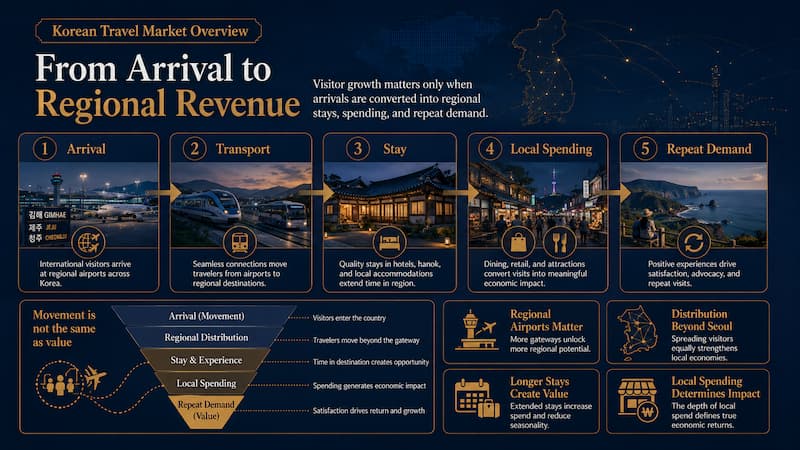
Arrival growth must be converted into local revenue
Korea’s inbound recovery is clearly visible at airports and cruise ports. Visitor numbers have moved beyond the initial rebound period, supported by the global popularity of Korean culture, the restoration of air services and strong demand from nearby Asian markets. Yet national arrival totals reveal only part of the economic picture.
The more important questions concern where visitors stay, how long they remain, what they purchase, which regions they enter and how much of their spending reaches tourism businesses. A traveller who spends an entire visit within a small number of central Seoul districts creates a different economic result from one who uses regional transport, local accommodation, restaurants, attractions and cultural experiences.
Korea’s inbound strategy therefore needs to move beyond counting arrivals. The next phase should measure how effectively visitors are distributed and how successfully their movement is converted into spending. Tourism policy must be able to show not only how many people entered the country, but also which destinations, communities and businesses received the benefit.
Visitor movement has value only when it produces measurable economic activity. Arrival growth without regional distribution, longer stays and higher local spending can increase congestion without creating a proportional return for the wider tourism industry.
Regional airports need products, not route announcements
Regional airports are again being positioned as important gateways in Korea’s tourism strategy. Direct international services can reduce visitor concentration in the Seoul metropolitan area and provide new access points to Busan, Jeju, Cheongju, Daegu, Muan and other regional markets. They can also give local residents more convenient access to overseas destinations and support regional business exchanges.
A new route, however, does not automatically create a viable destination. The airport must be connected to ground transportation, accommodation, attractions, local experiences and bookable travel products. Airlines also need a balanced mix of inbound and outbound demand if services are to survive after introductory promotions and route-launch ceremonies have ended.
Interline agreements and connecting networks could become increasingly important. Regional airports do not need to operate every long-haul service directly if passengers can move efficiently through commercially viable hubs. What matters is whether the entire journey can be booked, understood and completed without unnecessary inconvenience.
The performance of regional aviation should therefore be measured not by the number of routes announced but by the number that remain in operation, generate repeat demand and produce spending in the surrounding region. Routes are infrastructure. Tourism products are what turn that infrastructure into an economy.
Workation and long-stay travel remain unfinished markets
Korea possesses many of the conditions required to attract more workation and long-stay visitors, including advanced digital infrastructure, urban convenience, public safety, medical services and a strong cultural image. Visa policies can make entry possible, but they cannot create a functioning market on their own.
Long-stay travellers require suitable accommodation, work facilities, local communities, multilingual information, convenient payment systems and products designed for visits measured in weeks rather than days. Hotels, serviced residences, local governments and destination management companies need to recognise these visitors as a distinct segment rather than treating them as ordinary tourists staying slightly longer.
A workation visitor is not simply a leisure traveller carrying a laptop. The traveller lives, works, eats and spends within the destination over an extended period. This creates opportunities across accommodation, transport, retail, wellness, culture and regional services. It can also support destinations outside the busiest tourism periods if products are designed around local life rather than conventional sightseeing.
Korea has opened the door to long-stay demand, but the commercial structure behind it remains incomplete. The next task is to turn policy into bookable accommodation, local services and a coherent travel experience.
Travel News Market View
Korea’s travel recovery is giving way to a broader restructuring of the market. International aviation is expanding while domestic routes face stronger competition from rail and road transport. Japan and China remain the dominant short-haul markets, but Korean travellers are becoming more selective about price, convenience and product quality. Inbound arrivals continue to rise, yet the resulting economic benefits remain heavily concentrated by region and business sector.
Regional airports, connecting networks and long-stay policies could open new markets, but none will succeed through infrastructure or promotion alone. Airlines need profitable routes, airports need ground connections, destinations need bookable products and tourism businesses need systems capable of converting visitors into repeat customers.
The next winners in Korea’s travel market will be those able to connect five elements—access, product, distribution, conversion and repeat demand—within a single commercial structure. The question is no longer whether Korea’s travel market has recovered. It is what kind of market the country is building after the recovery.
여행레저신문 Copyrights ⓒ The Travel News. 무단전재 및 재배포 금지.
여행레저신문 Copyrights ⓒ The Travel News. 무단전재 및 재배포 금지.