

김미래 기자 ㅣ 여행레저신문
In the prologue to this series, we argued that success in the Korean market does not begin with a sales pitch, a one-off promotional event or a short burst of visibility. Korea is not a market where a destination, airline, hotel, resort or DMC can simply arrive, present itself once, and expect the relationship to take care of itself. It is a market where consumers, travel agents, media, airlines, hotels, local operators and partners repeatedly search, compare, ask, verify and return.
From this point forward, the question becomes more practical. What should foreign tourism boards and travel brands actually build first if they want to work effectively in Korea?
Our first answer is simple: they need a base camp.
Every serious market entry needs a place from which the work can be organised. Explorers need a base camp. Armies need an outpost. Brands entering a new market need a point of return. In tourism marketing, roadshows, press conferences, trade seminars, travel fairs, advertising, press releases, fam trips, newsletters and events all have their roles. None of them should be dismissed. But when these activities do not return to a common base, their value is often dispersed.
For many years, that base camp was a physical office. A tourism board or travel company would open an office in Seoul, hire local staff, receive calls, send out materials, brief agents, respond to journalists and manage campaigns. A physical office can still be valuable. But not every tourism board, airline, hotel, resort or DMC can afford to establish one in Korea. The cost is high, staffing is difficult, and for many organisations the Korean market must first be tested before a larger commitment is made.
That does not remove the need for a base camp. It only changes its form.
A Base Camp, Not Just Another Channel
A travel agent who attends a seminar needs somewhere to revisit the materials. A FIT traveller who sees an advertisement needs somewhere to read more in Korean. A journalist who receives a press release needs images, background and context. A person who could not attend a showcase or roadshow needs a way to catch up later. Without a Korean-language base, each activity risks becoming a separate moment rather than part of a continuing market presence.
This is why we would first recommend a Korean-language online base camp — and, in today’s Korean market, the most practical starting point is often a Naver Blog.
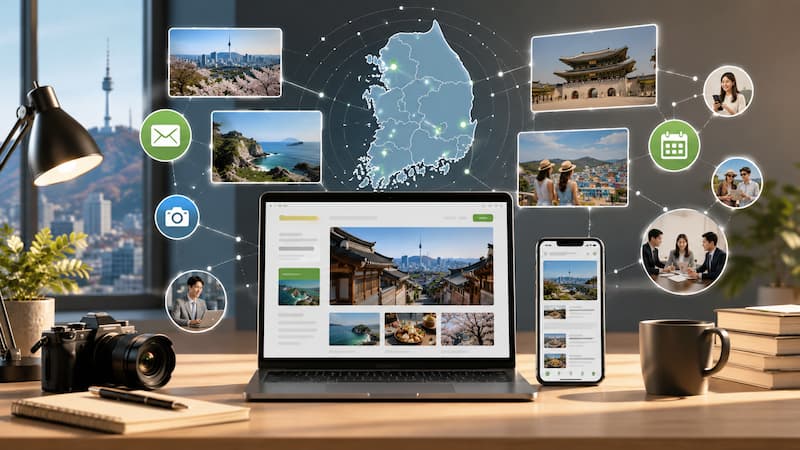
This is not an argument about liking Naver. It is not a claim that Naver is a perfect platform. It is a marketing judgment based on cost, efficiency and the way the Korean digital environment works. For many foreign tourism boards and travel brands, a Naver Blog is not merely a blog. Used properly, it can function as a Korean-language online office, a content archive, a campaign hub, a media room, a trade resource centre and a communication base.
A Korean-market online base camp should include the basic functions of a Korean-language website, but it should go further. It should introduce the destination, tourism board, airline partners, hotels and resorts, DMCs, inbound operators, product suppliers, seasonal itineraries, FIT information, trade materials and media resources. It can also carry photo libraries, photo news, video stories, press release archives, event notices, post-event reports, Q&A, FAQs and newsletter links.
At that point, the Naver Blog is no longer a simple posting channel. It becomes a working base for the Korean market.
The most important point is communication. A base camp should not be a one-way broadcasting board. Travel agents should be able to receive notices, review product materials and provide feedback. FIT travellers should be able to read practical information, join events or ask questions. Media should be able to find images and background. Airlines, hotels, DMCs and local partners should be able to see what message is being presented to Korea. Newsletter subscribers should be brought back to new stories, campaigns and events.
This is not merely two-way communication. It is multi-way communication.
A tourism board speaks to travel agents, consumers, media and partners. Travel agents respond with product questions. FIT travellers show interest through events and comments. Media use the materials for coverage. Hotels, airlines and DMCs can align their messages. Newsletter subscribers return to the base camp. In this structure, the blog becomes a place where different market actors can connect through one shared Korean-language platform.
Events can make this structure much stronger. Offline roadshows and showcases are limited by invitation lists, venue size and timing. Not every agent, journalist, partner or consumer can attend. An online event, however, can widen the field. A destination quiz, newsletter subscription event, seasonal campaign, travel-agent product idea event, or post-seminar Q&A can bring people into the base camp. Participants can become newsletter subscribers, content readers, campaign targets or future partners.
Newsletters are equally important. Sent alone, a newsletter can disappear quickly into an inbox. Connected to a base camp, it becomes a return route. Stories, press releases, photos, videos and event notices are stored on the blog; newsletters bring agents, journalists, partners and FIT consumers back to those materials. The content remains, the press release travels, the newsletter recalls the audience, and the event creates participation and feedback.

Why Naver Matters in Korea
This is where the low-cost, high-efficiency logic becomes important. Tourism marketing is always constrained by budget and people. Large campaigns may be useful, and physical offices may be ideal, but many organisations cannot begin there. A Naver Blog-based Korean online base camp allows them to start with a relatively light structure and build outward: content first, then press distribution, newsletters, events, trade communication and media support.
The Korean search market also supports this argument, although it should not be overstated. Korea is no longer a single-platform market. According to StatCounter, in May 2026 Google held 47.87 per cent of search-engine market share in Korea, while Naver held 41.67 per cent. That means Google and Naver now stand as two major forces rather than one platform simply dominating the market. But Naver’s relevance is not only a matter of search share. Its wider ecosystem — search, blogs, cafés, news, maps, shopping and content — still makes it a central environment in which Korean consumers and travel professionals discover, check and revisit information.
There are already examples in the market. Well-funded tourism boards such as H Tourism Board use Naver Blog actively as part of their Korean-language presence. At the same time, C Tourism Board shows another lesson: even a smaller organisation can begin efficiently by building a Naver Blog first, then connecting it with newsletters, events and ongoing content. The scale may differ, but the logic is the same. Both large and small tourism brands need a place in Korea that people can return to.
That is why the first recommendation is not simply “open a blog.” It is to build a Korean-market base camp through Naver Blog and operate it with a clear strategy. Storytelling articles, press releases, newsletters, events, photo and video assets, trade information, media materials and FIT-facing content should work together. A blog without this structure is just another channel. A blog with this structure becomes a market base.
The first condition for success in Korea is not necessarily a bigger campaign. It is a foundation that allows every campaign to connect. A roadshow should lead back to the base camp. A press conference should leave materials there. A trade seminar should be supported by follow-up content. An advertisement should take interested consumers somewhere deeper. A newsletter should bring readers back. An event should create participation, data and feedback.
For foreign tourism boards, airlines, hotels, resorts and DMCs entering Korea, the question is therefore not only, “What campaign should we run next?” It is, “Where will all of our Korean-market activities return?”
If a physical office is not yet possible, a Korean-language online base camp should come first. In the current Korean market, a Naver Blog-based structure is one of the most realistic low-cost, high-efficiency starting points. Not because Naver is perfect, and not because a blog alone can solve every problem, but because it can give a brand the one thing every market entry needs before it can grow: a place to stand.
여행레저신문 Copyrights ⓒ The Travel News. 무단전재 및 재배포 금지.